Abdomegaphobema mesomelas (O. Pickard-Cambridge, 1892): The Orange-kneed Tarantula.
- Cristian Porras Ramirez
- Oct 25, 2025
- 8 min read

Updated: Dec 30, 2025
Tarantulas of Costa Rica | Theraphosidae
English common names: Orange-kneed Tarantula, Costa Rican Orange-legged Tarantula, Black-bodied Orange-knee Tarantula, Red-patella Tarantula, Orange-jointed Forest Tarantula, Velvet-legged Tarantula, Central American Red-kneed Tarantula.

Recognition:
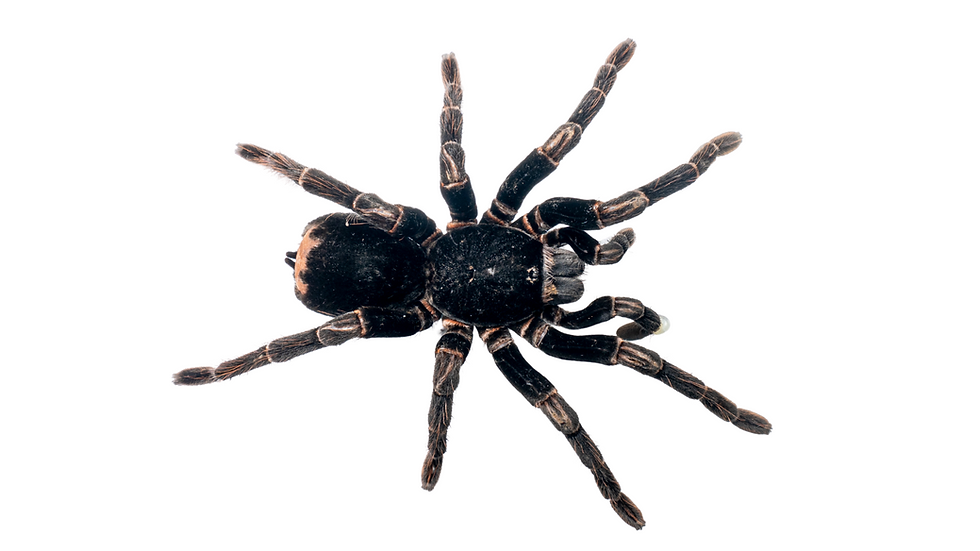
Abdomegaphobema mesomelas is a large, ground-dwelling tarantula recognized for its robust build and distinctive coloration. Adult females are estimated to reach a body length of 40–50 mm (excluding legs), with a diagonal leg span of up to approximately 13 cm. Adult males are typically smaller, with body lengths ranging from 30–40 mm, and proportionally longer legs. The carapace and opisthosoma are uniformly dark brown to black, often with a matte, velvety texture due to dense coverage of fine setae.
The most striking feature of this species is the vivid reddish-orange coloration on the patellae (knee segments), which may also extend partially onto the femora and tibiae. This color contrast makes A. mesomelas one of the most visually distinctive tarantulas in Costa Rica.
Structurally, the species exhibits the stout morphology characteristic of Theraphosinae, including thick femora and dense setation across the body. Like other members of this subfamily, it bears Type I urticating setae on the dorsal surface of the abdomen, which are used defensively when threatened (Cooke et al., 1972).
Sexual dimorphism is evident in mature specimens. Males possess tibial apophyses (spurs) on the first pair of legs, used during courtship, as well as modified pedipalps with bulbous palpal organs for sperm transfer. They are generally more slender and have relatively longer legs than females. Females, in contrast, lack tibial spurs and exhibit a more robust body, with paired spermathecae used for sperm storage.
In the field, A. mesomelas may be confused with other dark-bodied theraphosids from Costa Rica, particularly species of Sericopelma. However, the combination of overall morphology and vivid orange patellae offers a reliable distinguishing feature for adults. Nonetheless, definitive species-level identification—especially in juveniles or closely related taxa—requires microscopic examination of reproductive structures, including the shape of the male palpal bulb or the female spermathecae (Bertani, 2001).
Natural History:
The natural history of Abdomegaphobema mesomelas remains largely undocumented in the scientific literature. Nevertheless, aspects of its ecology can be reasonably inferred from its morphology and from behavioral patterns observed in related Theraphosinae genera inhabiting similar Neotropical habitats (Bertani, 2001; Pérez‑Miles et al., 2008).
This species is presumed to be terrestrial and fossorial, adapted to the forest floor of humid tropical and premontane ecosystems. It likely occupies shallow burrows or natural cavities beneath rocks, logs, or roots, which serve as refuges during daylight hours and as ambush sites for nocturnal foraging (Foelix, 2011). Field observations and photographic records suggest that A. mesomelas is primarily nocturnal, emerging after dusk to prey on terrestrial arthropods such as beetles, cockroaches, and crickets. Large females may occasionally capture small vertebrates such as frogs or lizards, though invertebrates likely constitute the bulk of the diet.
Reproductive behavior for this species has not been documented. In other Central American theraphosids, reproductive activity generally coincides with the onset of the rainy season (May–November), when humidity and prey abundance increase (Valerio, 1980). Detailed studies on courtship, egg sac construction, and juvenile development remain unavailable.
Defensive behavior in A. mesomelas is expected to resemble that of other Theraphosinae. When threatened, individuals may release Type I urticating setae from the abdomen using the hind legs (Cooke et al., 1972). If further provoked, the spider may adopt a threat posture by elevating its front legs and displaying the chelicerae. While bites are rare, they can occur under continued disturbance. Its venom has not been analyzed, but by analogy with related species, it is unlikely to pose medical significance to humans, typically causing only mild, localized effects. The spider’s dark, matte coloration provides effective camouflage on the forest floor, especially under low light conditions.
In summary, while empirical data on Abdomegaphobema mesomelas are still lacking, available evidence suggests it conforms to the ecological and behavioral profile typical of large-bodied terrestrial tarantulas inhabiting humid Neotropical forests.
Conservation:
Abdomegaphobema mesomelas has not been evaluated by the IUCN Red List (IUCN, 2025), and no species-specific conservation status has been assigned under Costa Rican legislation, such as the Ley de Conservación de Vida Silvestre No. 7317 (República de Costa Rica, 1992). However, as with many Neotropical theraphosids, it may be exposed to several indirect threats that merit attention.
One of the primary concerns is habitat loss, particularly in areas outside the national protected area system. Although Costa Rica has made notable progress in forest conservation—especially through its network of national parks and biological reserves—land outside these zones continues to face deforestation and fragmentation due to agriculture, livestock expansion, and urban development. Since A. mesomelas is likely dependent on humid tropical and premontane forests, such changes may negatively impact its populations.
Another potential threat is the exotic pet trade. While there is no published evidence that this species is being collected at significant levels, its striking coloration and large size could make it attractive to international hobbyists and collectors. Similar scenarios have occurred with other theraphosid species in Central America, suggesting a need for trade monitoring and early regulation if collection is detected.
Climate change poses an additional concern. Changes in rainfall patterns, temperature, and humidity may alter the microhabitats this species depends on, particularly if it has narrow physiological tolerances typical of other forest-dwelling tarantulas (Foelix, 2011).
Due to the lack of ecological and demographic data, the species’ resilience remains unknown. Like other Theraphosinae, A. mesomelas likely exhibits slow maturation—with males taking 2–4 years to reach maturity and females potentially living over a decade—and low reproductive output, typically producing a single egg sac annually with limited dispersal. These traits make the species inherently vulnerable to population declines when exposed to sustained external pressures.
Distribution:
Abdomegaphobema mesomelas was first described by O. Pickard-Cambridge in 1892, based on a female specimen from Costa Rica (Pickard-Cambridge, 1892). As was common in 19th-century arachnological work, the type locality was imprecisely listed simply as “Costa Rica,” without further geographic detail. This lack of specificity complicates modern efforts to define the species’ range and ecological limits.
To date, the species is considered endemic to Costa Rica, but its exact distribution remains poorly documented. There are no published records pinpointing specific collection localities beyond the original description, and no modern mapping of its range exists in peer-reviewed literature. The World Spider Catalog (2025) confirms its presence solely in Costa Rica, without further detail on province-level occurrence.
Some observational data, including a few unverified or tentative records from citizen science platforms such as iNaturalist, suggest that A. mesomelas may occur in humid lowland and premontane forests, possibly on the Caribbean slope and in parts of the Central Valley. These hypotheses are based on general habitat preferences shared with other large-bodied Theraphosinae and the assumption of ecological conservatism within the genus. However, no published voucher specimens from specific provinces have been cited in scientific literature or museum databases.
Estimates of its altitudinal range—typically placed between 600 and 1500 meters above sea level—are likewise inferential and have not been formally published. These ranges reflect the ecological zones where similar theraphosid taxa are found, rather than confirmed records for A. mesomelas itself.
The scarcity of confirmed records and the taxonomic difficulty of identifying tarantulas in the field—especially in the absence of adult males or dissected females—highlight the urgent need for targeted field surveys, expert examination of reproductive structures, and the deposition of voucher specimens in institutional collections. Until such efforts are undertaken, the known distribution of Abdomegaphobema mesomelas remains provisional and incomplete.

Etymology
The genus name Abdomegaphobema is a constructed compound that integrates Latin and Greek roots. The element "abdomen" (Latin) refers to the spider’s prominent opisthosoma or posterior body segment, a defining feature in many theraphosids. The prefix "mega" (Greek: μέγας, megas) means "large" or "great," while "phobema" (Greek: φόβημα, phóbēma) can be translated as "a fearful thing" or "that which causes fear." Taken together, Abdomegaphobema can be interpreted as “large fearsome abdomen” or “fearsome large-bodied spider”, evoking the imposing appearance of these robust tarantulas.
The specific epithet "mesomelas" also derives from Greek roots: "meso-" (μέσος) meaning "middle" or "central," and "melas" (μέλας) meaning "black" or "dark." The name likely refers to the spider’s dark central body coloration, particularly the uniformly black opisthosoma, which contrasts sharply with the vivid orange joints of the legs.
Combined, the full binomial name Abdomegaphobema mesomelas may be interpreted as:
“the fearsome, large-bodied spider with a black middle” — a fitting description for a species notable for both its size and contrasting color pattern.
Synonymy
The taxonomic history of Abdomegaphobema mesomelas illustrates the complexities and ongoing revisions typical in the classification of Neotropical theraphosids. The species was originally described as Eurypelma mesomelas by O. Pickard-Cambridge in 1892, based on a female specimen from Costa Rica (Pickard-Cambridge, 1892). At the time, Eurypelma functioned as a broad, catch-all genus for many poorly known New World tarantulas.
Subsequent authors reassigned the species to other genera as taxonomic understanding advanced. It was temporarily placed in Citharacanthus and later in Crypsidromus, reflecting attempts to align morphological characters—particularly reproductive and somatic traits—with emerging generic concepts. These transfers were typical of 20th-century theraphosid taxonomy, which often lacked the rigorous phylogenetic framework now available.
During the late 20th and early 21st centuries, the species was frequently referred to as Megaphobema mesomelas, due to perceived morphological similarities to other members of Megaphobema, such as robust leg morphology and size. However, this placement was not supported by detailed morphological or phylogenetic analyses.
The current placement of the species in the genus Abdomegaphobema is based on more recent revisions of Theraphosinae that take into account key diagnostic traits—including differences in palpal bulb morphology, spermathecal shape, and proportions of posterior lateral spinnerets. This classification is reflected in the World Spider Catalog (2025) and is accepted in contemporary arachnological literature. Nonetheless, as with many Neotropical tarantulas, the generic boundaries remain subject to change pending future phylogenetic studies involving both morphological and molecular data.
1892 – Eurypelma mesomelas O. Pickard-Cambridge → Original description based on a female specimen from Costa Rica.
20th century – Citharacanthus mesomelas → Reassigned during early taxonomic revisions of Central American tarantulas.
Mid-20th century – Crypsidromus mesomelas → Temporarily placed here; Crypsidromus now considered taxonomically unstable.
Late 20th – early 21st century – Megaphobema mesomelas → Used in hobby and grey literature; never formally published.
Current (2020s) – Abdomegaphobema mesomelas (O. Pickard-Cambridge, 1892) → Valid name according to the World Spider Catalog (2025), based on updated morphological analysis.
Literature Cited:
Bertani, R. (2001). Revision, cladistic analysis and zoogeography of Vitalius, Nhandu, and Proshapalopus, with notes on other theraphosine genera (Araneae, Theraphosidae). Arquivos de Zoologia, 36(3), 265–356. https://doi.org/10.11606/issn.2176-7793.v36i3p265-356
Cooke, J. A. L., Roth, V. D., & Miller, F. H. (1972). The urticating hairs of theraphosid spiders. American Museum Novitates, 2498, 1–43. https://digitallibrary.amnh.org/items/14fb9938-27fa-4c01-92e8-2a7a89e1585c
Foelix, R. F. (2011). Biology of spiders (3rd ed.). Oxford University Press.
Instituto Nacional de Biodiversidad (INBio). (n.d.). Colecciones y bases de datos de artrópodos de Costa Rica. Santo Domingo de Heredia, Costa Rica. [Información sobre registros históricos de artrópodos]. (No hay URL directa al archivo, pero INBio ha sido fuente reconocida en biodiversidad nacional.)
International Union for Conservation of Nature (IUCN). (2025). The IUCN Red List of Threatened Species (Version 2025-1). https://www.iucnredlist.org
Pérez-Miles, F., Gabriel, R., Miglio, L., Bonaldo, A., Gallon, R., Jiménez, J. J., & Bertani, R. (2008). Ami, a new theraphosid genus from Central and South America, with the description of six new species (Araneae: Mygalomorphae). Zootaxa, 1915(1), 54–68. https://doi.org/10.11646/zootaxa.1915.1.1
Pickard-Cambridge, O. (1892). Arachnida - Araneida. In F. D. Godman & O. Salvin (Eds.), Biologia Centrali-Americana, Zoology (Vol. 1, pp. 89–104). London: Taylor and Francis. (Disponible en bibliotecas digitales y colecciones históricas).
República de Costa Rica. (1992). Ley de Conservación de la Vida Silvestre No. 7317. La Gaceta No. 235. https://www.sinac.go.cr/ES/legal/leyes/LEY%207317.pdf
Strand, E. (1929). Zoological and palaeontological nomenclatorical notes. Acta Universitatis Latviensis, 20, 1–29.
World Spider Catalog. (2025). Abdomegaphobema mesomelas (O. Pickard-Cambridge, 1892). Version 25.0. Natural History Museum Bern. https://wsc.nmbe.ch/species/37678
iNaturalist. (2025). Observations of Abdomegaphobema mesomelas [Research-grade records, subject to expert verification]. https://www.inaturalist.org
Disclaimer
This section was prepared by a team of dedicated enthusiasts and biologists with a strong interest in Costa Rica’s native tarantulas. The information presented here is based on publicly available scientific literature, verified observational records (including citizen science platforms), and collective field experience.
While every effort has been made to ensure accuracy, this content has not yet undergone formal peer review by a professional arachnologist specializing in Theraphosidae. As such, we recommend that taxonomic or ecological interpretations especially those used in scientific or conservation contexts be independently reviewed by qualified specialists in the field.
We actively welcome collaboration with professional arachnologists and invite readers to contribute verified data, photographs, corrections, or updates. Our goal is to continually refine and expand this resource to support greater understanding, appreciation, and protection of Costa Rica’s remarkable tarantula fauna.


Comments