Abdomegaphobema peterklaasi (Schmidt, 1994): Peter Klaas’ Costa Rican tarantula.
- Cristian Porras Ramirez
- Dec 30, 2025
- 10 min read

Tarantulas of Costa Rica | Theraphosidae
English common names:
Peter Klaas’ Costa Rican tarantula, Costa Rican black Megaphobema, black-legged Costa Rican tarantula.
Recognition
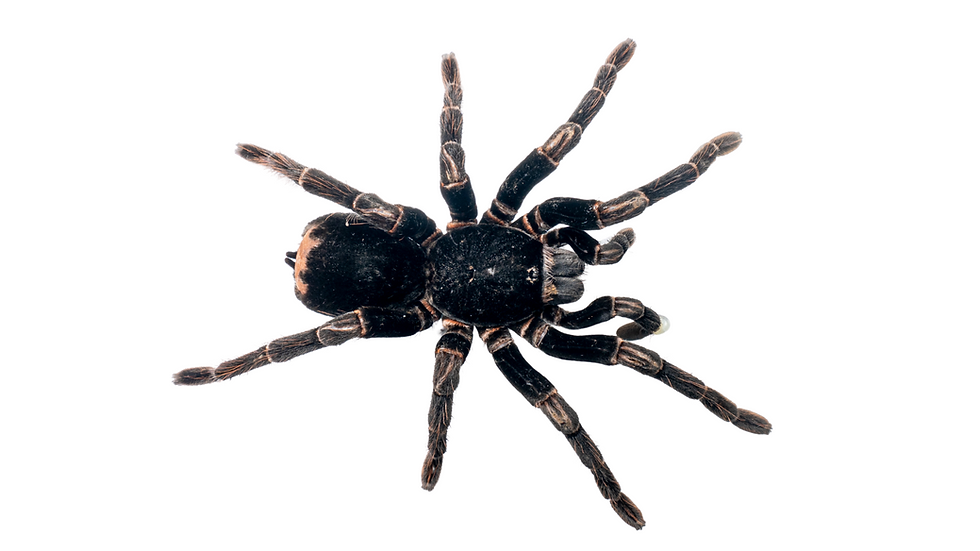
Abdomegaphobema peterklaasi is a medium-to-large theraphosid characterized by a uniformly dark coloration, a velvety opisthosoma, and distinctive genital morphology. Adult females reach a total body length of approximately 56 mm, while adult males are smaller and more slender, measuring around 42 mm in total length (Schmidt, 1994) . In females, the carapace measures about 26 mm in length and 22 mm in maximum width, whereas males present a slightly smaller carapace, approximately 24 × 20 mm. The opisthosoma is proportionally large and broad in females (up to 30 × 22 mm) and noticeably narrower in males (ca. 18 × 11 mm) (Schmidt, 1994) . Fully grown specimens commonly attain a leg span of 14–16 cm, with males exhibiting proportionally longer legs, a typical pattern within Theraphosinae (Schmidt, 2003) .
The general coloration is uniform dark brown to blackish, lacking contrasting leg banding or conspicuous patterning. The carapace is dark brown, slightly lighter than the legs, and densely clothed with short, fine setae. The opisthosoma is covered with short, velvety hairs, giving it a matte appearance rather than a glossy sheen, a feature explicitly noted in the original description (Schmidt, 1994) . Legs are uniformly dark, without annulations, and bear long, dark setae; femora III and IV are only slightly thicker than femora I and II, producing a relatively even and robust leg profile.
Urticating setae typical of Theraphosinae are present on the dorsal surface of the opisthosoma, forming a dense patch used in defense. Scopulae are well developed on all tarsi and on metatarsi I and II, while metatarsi III and IV show partial scopulation, consistent with related theraphosine genera (Schmidt, 1997; Schmidt, 2003) . Spination is moderate and does not present exaggerated or specialized structures.
Sexual dimorphism is pronounced. Males are more gracile, with proportionally longer legs and a distinct tibial apophysis on leg I, consisting of a retroventral process with a characteristic thorn-like projection, a feature important for distinguishing this species from superficially similar taxa (Schmidt, 1994; Sherwood et al., 2023) . The male palpal bulb is elongated with a slender, gently curved embolus, lacking complex keels or extreme modifications. Females are more robust and are diagnosed by their very large spermatheca, approximately 6 mm wide, bearing two small lateral protuberances, a key character separating A. peterklaasi from A. mesomelas and from species historically placed in Megaphobema (Schmidt, 1994; Gabriel, 2024; Sherwood et al., 2023) .
Juveniles resemble adults in general morphology but tend to be lighter brown and less uniformly dark, with a proportionally larger opisthosoma. Due to its dark, patternless appearance, A. peterklaasi may be confused in the field with other Central American theraphosines; therefore, examination of adult genital structures is generally required for reliable species-level identification (Sherwood et al., 2023).
Natural History
The natural history of Abdomegaphobema peterklaasi is poorly documented, and no study has been specifically dedicated to its ecology or behavior in the wild. Available information is derived primarily from the original species description, subsequent taxonomic revisions, comparative data from closely related theraphosines, and a limited number of reliable field observations from Costa Rica (Schmidt, 1994; Schmidt, 2003; Sherwood et al., 2023) .
This species is a terrestrial theraphosine, inferred to be primarily fossorial or semifossorial, spending most of the daylight hours within burrows or natural retreats. As with other Central American theraphosines, individuals are presumed to inhabit self-excavated burrows or to occupy pre-existing cavities beneath rocks, fallen logs, or dense root systems, often reinforcing these retreats with silk lining at the entrance (Schmidt, 2003) . There is no evidence suggesting arboreal or semi-arboreal behavior.
Activity is presumed to be nocturnal, with individuals emerging after dusk to forage, a pattern typical of large terrestrial tarantulas in tropical environments. During daylight hours, spiders likely remain concealed within their retreats to avoid predation and desiccation. Seasonal activity is expected to increase during the rainy season, when humidity is higher and prey availability is greater, although this has not been formally quantified for this species (Schmidt, 2003) .
The diet of A. peterklaasi has not been documented directly in the wild, but it is inferred to consist mainly of large insects and other arthropods, such as orthopterans, beetles, cockroaches, and possibly other spiders. As with other large theraphosids, opportunistic predation on small vertebrates (e.g., amphibians or lizards) is theoretically possible but remains unrecorded for this species and should be considered speculative.
Defensive behavior is inferred to follow the typical pattern of New World theraphosines. The species possesses urticating setae on the dorsal opisthosoma and is expected to rely primarily on hair flicking as a first line of defense, combined with retreat into its burrow. When threatened, individuals may adopt a defensive posture with raised forelegs and exposed fangs; however, biting behavior is likely a last resort, as in most theraphosids (Schmidt, 1997; Schmidt, 2003) .
Reproductive biology is unknown in detail. Male maturation is presumed to be seasonal, with adult males leaving their burrows to search for females, as observed in other Costa Rican theraphosines. Courtship, mating behavior, egg sac construction, clutch size, and juvenile development have not been described specifically for A. peterklaasi. Based on related taxa, females likely produce a single egg sac per reproductive event, containing several dozen to over a hundred eggs, followed by extended maternal care within the burrow (Schmidt, 2003) .
At present, no ecological data derived from long-term field studies, population monitoring, or experimental observations are available for this species. Most ecological inferences are extrapolated from general theraphosine biology and from closely related Central American taxa. Sherwood et al. (2023) explicitly note that the recent taxonomic reassessment of A. peterklaasi was based on morphological evidence rather than ecological or behavioral data, highlighting the need for targeted natural history studies in Costa Rica.
Conservation
Abdomegaphobema peterklaasi has not been evaluated by the IUCN Red List and currently lacks a formal conservation status. As a Costa Rican endemic with an apparently restricted distribution, the species is potentially vulnerable to habitat loss and fragmentation, particularly due to deforestation, agricultural expansion, urban development, and infrastructure projects that affect soil structure and forest floor microhabitats. Although no population data are available, its presumed dependence on terrestrial, forest-associated environments suggests sensitivity to environmental disturbance (Schmidt, 2003; Sherwood et al., 2023) .
Additional potential threats include human persecution driven by fear, and a low but possible risk from the exotic pet trade, especially following recent taxonomic clarification that may increase collector interest (Gabriel, 2024). Like many theraphosines, the species likely exhibits slow growth, delayed maturity, and low reproductive frequency, traits that can limit recovery from population declines. Targeted field surveys, ecological studies, and public education are needed to clarify its conservation status and support long-term protection efforts.
Distribution
Abdomegaphobema peterklaasi is endemic to Costa Rica. The original description lists the type locality simply as Costa Rica, without precise geographic coordinates, a common limitation in older taxonomic works (Schmidt, 1994) . Type specimens are deposited in European institutional collections, and no additional type-locality refinement was provided in the original publication.
Subsequent taxonomic and revisionary works confirm the species as a Costa Rican endemic and do not report verified records outside the country (Schmidt, 2003; Sherwood et al., 2023) . Due to historical confusion with related taxa formerly placed in Megaphobema, the precise provincial distribution within Costa Rica remains unclear. At present, there are no published distribution maps, detailed locality records, or confirmed voucher-based records specifying provinces, elevations, or bioclimatic zones.
The lack of precise locality data, combined with limited field sampling and potential misidentifications, represents a major gap in knowledge. Future integration of museum material, targeted field surveys, and carefully validated citizen-science records could allow the construction of an updated distribution map and clarify the species’ ecological and altitudinal range (Sherwood et al., 2023).

Etymology
The generic name Abdomegaphobema was established by Sherwood et al. (2023) to accommodate Costa Rican species previously misplaced in Megaphobema. The name is derived from Latin abdomen (belly, opisthosoma) combined with Megaphobema, the genus with which these species were historically associated. The compound name refers to the diagnostically distinctive opisthosomal and genital morphology, particularly features of the abdomen and female spermathecae, that separate these taxa from true Megaphobema species and justify their placement in a distinct genus (Sherwood et al., 2023) .
The specific epithet peterklaasi is a patronym honoring Peter Klaas, a German arachnologist and prominent contributor to the study and popularization of theraphosid spiders. The name was explicitly dedicated to him by Schmidt (1994) in the original description of the species, recognizing his contributions to theraphosid taxonomy and husbandry literature . The combined binomen Abdomegaphobema peterklaasi may therefore be interpreted as “the Megaphobema-like tarantula with distinctive abdominal characters, dedicated to Peter Klaas,” reflecting both its taxonomic history and the individual honored by its name.
Synonymy
The species was originally described as Megaphobema peterklaasi Schmidt, 1994, based on material from Costa Rica, with the type locality broadly stated as “Costa Rica” and without precise geographic restriction (Schmidt, 1994) . For nearly three decades, the species remained placed in Megaphobema, and this combination was followed in subsequent catalogs and secondary literature, including regional and global overviews of Theraphosidae (Schmidt, 1997, 2003; Peters, 2000, 2003) .
A comprehensive morphological reassessment by Sherwood et al. (2023) demonstrated that M. peterklaasi does not conform to the diagnostic characters of Megaphobema, particularly with respect to female spermathecal structure, male tibial apophysis morphology, femoral armature, and stridulatory organs. As a result, the authors erected the new genus Abdomegaphobema and transferred the species accordingly, establishing the currently valid name Abdomegaphobema peterklaasi (Schmidt, 1994) comb. nov. (Sherwood et al., 2023) . This taxonomic change has since been accepted by the World Spider Catalog and supported by subsequent commentary and comparative analyses (Gabriel, 2024) .
Chronological synonymy:
Megaphobema peterklaasi Schmidt, 1994 — original description
Abdomegaphobema peterklaasi (Schmidt, 1994) — current valid combination (Sherwood et al., 2023)
No junior synonyms or historical misidentifications formally assigned to this species have been documented to date.
Remarks / Curiosities
Abdomegaphobema peterklaasi is notable for its uniformly dark, almost black appearance, which contrasts with the more conspicuously patterned coloration seen in many Costa Rican theraphosines. This subdued coloration likely provides effective camouflage against dark soils and leaf litter, rendering individuals difficult to detect in the field and potentially contributing to the scarcity of confirmed records (Schmidt, 1994; Schmidt, 2003).
A historically noteworthy aspect of A. peterklaasi is that the species was already circulating within the European tarantula hobby prior to its formal scientific description. On 25 March 1994, Günter Schmidt received a female specimen from Mr. Lang (Ludwigsburg) and a male from Mr. Scheuermann, both belonging to a previously unknown theraphosid species discovered in Costa Rica by Peter Klaas. By that time, specimens had already been displayed at tarantula exhibitions earlier in the year and were being maintained by several German enthusiasts. Owing to its overall appearance, the species was initially assumed to represent a melanistic form of Abdomegaphobema mesomelas (Cambridge, 1897). Only subsequent detailed morphological examination, particularly of genital characters, demonstrated that it represented a distinct species within the mesomelas group. Remarkably, based on its general habitus and setation, experienced hobbyists had already placed the species correctly within Megaphobema sensu lato even before a formal scientific description existed (Schmidt, 1994).
Of particular interest are populations of Abdomegaphobema mesomelas from the Turrialba region, near Guayacán, which exhibit morphs strikingly similar to A. peterklaasi. These mesomelas morphs display strongly reduced orange coloration and only faint expression of orange tones on the patellae (“knees”), rendering them superficially almost indistinguishable from A. peterklaasi. This resemblance makes field identification especially challenging and may contribute to misidentifications. To date, this observation has not been formally documented in the scientific literature and warrants targeted morphological and molecular investigation to determine whether it reflects intraspecific color variation, geographic polymorphism, or an unresolved taxonomic signal. Until such studies are undertaken, reliable discrimination between these taxa should rely on adult genital morphology, particularly female spermathecae and male palpal characters (Sherwood et al., 2023; Gabriel, 2024).

Literature Cited
Gabriel, R. (2024). What’s this with all these Megaphobema and Pamphobeteus petersi changes and why? Journal of the British Tarantula Society, 38(3), 5–18.
Peters, H.-J. (2000). Tarantulas of the world: Kleiner Atlas der Vogelspinnen (Vol. 2). Wegberg, Germany: Published by the author.
Peters, H.-J. (2003). Tarantulas of the world: America’s Vogelspinnen. Wegberg, Germany: Published by the author.[Note: Some species-level information in this work has been considered unreliable by later authors.]
Schmidt, G. (1994). Eine weitere Megaphobema-Art aus Costa Rica (Araneida: Theraphosidae: Theraphosinae). Arachnologisches Magazin, 2(11), 1–6.
Schmidt, G. (1997). Bestimmungsschlüssel für die Gattungen der Unterfamilie Theraphosinae (Araneae: Theraphosidae). Arachnologisches Magazin, 3 (Sonderausgabe), 1–27.
Schmidt, G. (2003). Die Vogelspinnen: Eine weltweite Übersicht. Neue Brehm-Bücherei 641. Hohenwarsleben, Germany: Westarp Wissenschaften.
Sherwood, D., Gabriel, R., Peñaherrera-R., P., León-E., R. J., Cisneros-Heredia, D. F., Brescovit, A. D., & Lucas, S. M. (2023). Pamphobeteus Pocock, 1901: Redescriptions, new species and records, description of a missing sex, with taxonomic notes and changes in Megaphobema Pocock, 1901 (Araneae: Theraphosidae). Arachnology, 19(6), 894–930. https://doi.org/10.13156/arac.2023.19.6.894
World Spider Catalog. (2025). World Spider Catalog, version 25.0. Natural History Museum Bern. https://wsc.nmbe.ch/spec-data/44303
Disclaimer
This section was prepared by a team of dedicated enthusiasts and biologists with a strong interest in Costa Rica’s native tarantulas. The information presented here is based on publicly available scientific literature, verified observational records (including citizen science platforms), and collective field experience.
While every effort has been made to ensure accuracy, this content has not yet undergone formal peer review by a professional arachnologist specializing in Theraphosidae. As such, we recommend that taxonomic or ecological interpretations especially those used in scientific or conservation contexts be independently reviewed by qualified specialists in the field.
We actively welcome collaboration with professional arachnologists and invite readers to contribute verified data, photographs, corrections, or updates. Our goal is to continually refine and expand this resource to support greater understanding, appreciation, and protection of Costa Rica’s remarkable tarantula fauna.


Comments