Aphonopelma seemanni (F. O. Pickard-Cambridge, 1897): Costa Rican Zebra Tarantula.
- Cristian Porras Ramirez
- Oct 25, 2025
- 13 min read

Updated: Dec 30, 2025
Tarantulas of Costa Rica | Theraphosidae
English common names: Costa Rican Zebra Tarantula, Striped-knee Tarantula, Striped Tarantula, Black and White Tarantula, Black-bodied Zebra Tarantula, White-striped Tarantula.

Recognition
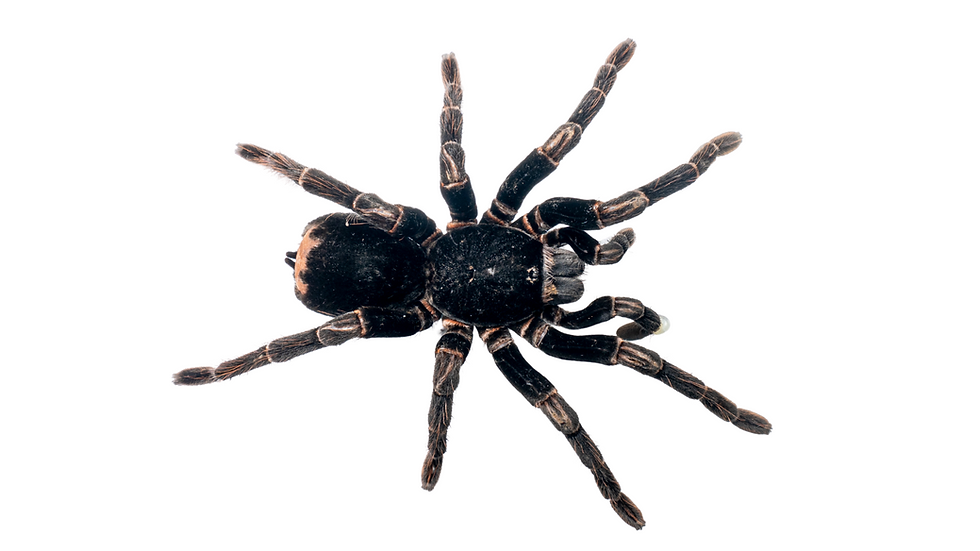
Aphonopelma seemanni (F. O. Pickard-Cambridge, 1897) is one of the most morphologically distinctive tarantulas in Central America, easily recognized in the field due to its unique coloration and moderate body size. Adult females typically reach a body length of 5.0–6.5 cm, while adult males are slightly smaller, ranging from 4.5 to 5.5 cm. The average leg span in mature individuals ranges from 10 to 13 cm, depending on age, sex, and environmental conditions (Venegas, 2020; Pickard-Cambridge, 1897). These dimensions are consistent with museum specimens and field observations in Costa Rica and Nicaragua.
The species’ most diagnostic feature is the presence of bold, pale transverse bands on the patellae and tibiae of all legs, usually white or cream-colored, which contrast sharply against the otherwise black to dark brown integument. This banded leg pattern forms the basis for its common name, the “Zebra Tarantula,” and serves as the primary field-level identification trait. The carapace is uniformly dark but may exhibit a subtle bronze or olive iridescent sheen under strong lighting conditions. The abdomen (opisthosoma) is typically dark brown to black, covered in short, velvety setae, and may present scattered reddish guard hairs. These features result in a soft-textured, velvet-like appearance in freshly molted specimens.
In terms of general morphology, females are robust, stocky, and broad-bodied, with proportionally thicker femora and a well-developed opisthosoma. Males, in contrast, exhibit sexual dimorphism upon reaching maturity, including a more gracile build, longer legs, and reduced body mass. Mature males also possess tibial apophyses (spurs) on the first pair of legs, which are used to secure the female during mating. Additionally, their palpal bulbs are fully developed and globose with simple emboli, consistent with other Aphonopelma species (Hamilton et al., 2016). Female spermathecae, while not illustrated in most regional field guides, are reported in the genus to be paired and unfused, which differentiates it from closely related genera such as Sericopelma.
Juveniles are morphologically similar to adults but often show fainter leg striping and paler overall coloration. This can occasionally lead to misidentification, particularly with young individuals of Sericopelma or Davus species. However, the presence of tibial banding, even if reduced, along with habitat context and overall proportions, typically allows for confident identification.
Among sympatric species, Aphonopelma seemanni can be confused with A. burica or A. crinirufum, but these species lack the high-contrast leg bands and usually exhibit more uniform leg coloration. Unlike Sericopelma, which tends to be larger and presents different spermathecal morphology and coloration, A. seemanni retains a distinct visual profile. Although external morphology is often sufficient for field recognition, definitive identification especially in females and juveniles may require examination of reproductive structures.
Natural History
Aphonopelma seemanni is a fossorial theraphosid inhabiting primarily lowland and premontane tropical ecosystems along the Pacific slope of Costa Rica, extending northward into Nicaragua and southern Honduras (Pickard-Cambridge, 1897; Venegas, 2020). Within Costa Rica, it is especially common in the North Pacific and Central Pacific regions, including the Guanacaste lowlands, Nicoya Peninsula, and certain areas of the central valley. This distribution suggests a preference for seasonally dry forests, but the species also occurs in transitional habitats and secondary growth, displaying considerable ecological plasticity.
A. seemanni occupies well-drained, clay-rich soils where it excavates its own vertical or angled burrows, often reinforced with silk. Burrows are typically located beneath fallen logs, rocks, or root systems, and may reach depths of 20 to 40 cm, depending on soil type and moisture (Venegas, 2020). In more disturbed areas, including agroecosystems such as pasture edges and rural gardens, the species has been recorded reusing natural cavities, rodent burrows, or spaces between tree roots. Although A. seemanni is not endemic to a single ecological region, it shows a clear affinity for Pacific slope habitats, where wet-dry seasonality shapes its activity patterns.
Behaviorally, A. seemanni is nocturnal, emerging from its burrow shortly after dusk to forage or bask near the entrance. During the day, it remains hidden, typically with the burrow entrance partially sealed or camouflaged with silk and debris. Foraging peaks at nightfall and early night hours, especially during the early rainy season (May–July), when humidity increases and prey is more abundant. In the dry season, it often remains inactive or deep within the burrow, conserving moisture and energy.
Burrow entrances are frequently lined with silk, and in some cases, the opening is sealed during molting periods or ootheca incubation. While individuals are capable of digging new burrows, they often reuse or adapt pre-existing shelters, particularly in areas with limited soil penetrability. The silk-lining not only stabilizes the burrow walls but may also function in prey detection through vibratory cues.
The diet of A. seemanni consists primarily of invertebrates, including crickets, beetles, cockroaches, and orthopterans. In captivity, they accept a wide range of standard prey, and anecdotal reports suggest they may opportunistically prey upon small vertebrates, such as geckos or frogs, although such behavior remains undocumented in wild populations (Venegas, 2020). Their hunting strategy is typical of sit-and-wait ambush predators, relying on vibratory signals near the burrow entrance.
Reproductive activity is seasonally timed, with mature males typically appearing at the onset of the rainy season, often between late May and July. These males exhibit classic wandering behavior, leaving their burrows and actively seeking females. Courtship and mating likely occur during this same window, though precise behavioral sequences remain undescribed in scientific literature. Females are known to produce a single ootheca per year, containing an estimated 300–500 eggs. The development time of spiderlings is relatively slow, consistent with other Aphonopelma species, requiring multiple molts over 2–3 years to reach maturity under natural conditions (Hamilton et al., 2016).
In terms of defense, A. seemanni possesses Type I urticating hairs, located on the abdomen, which may be deployed when provoked. However, individuals are generally non-aggressive, preferring to retreat into their burrows rather than confront threats. Defensive postures (raised front legs, exposed chelicerae) have been observed but are rare. The dark coloration of the carapace and legs provides moderate camouflage against the forest floor and leaf litter, particularly at night.
Seasonality plays a central role in this species’ behavior. Peak activity, both for foraging and reproduction, coincides with the early wet season, when environmental conditions (humidity, temperature, prey availability) are optimal. During the dry season (December–April), individuals may become semi-dormant, rarely emerging except under favorable conditions. The synchronized appearance of adult males suggests a strong response to climatic cues, particularly rainfall and humidity thresholds.
Despite its widespread distribution and recognizable appearance, few peer-reviewed studies have focused on the ecology of A. seemanni. Most ecological information comes from field observations, captive reports, and citizen science platforms such as iNaturalist and GBIF, where numerous geo-referenced records help define its ecological range. The species is occasionally included in biodiversity surveys in protected areas such as the Área de Conservación Guanacaste (ACG), but detailed ecological data remain limited.
Conservation
As of 2025, Aphonopelma seemanni has not been evaluated by the IUCN Red List, and therefore holds the status of Not Evaluated (NE) in global conservation frameworks. Similarly, the species does not appear on national endangered species lists or legal instruments such as Costa Rica’s Wildlife Conservation Law (Ley 7317). Despite this, A. seemanni benefits indirectly from habitat protection within several Wildlife Protected Areas, including national parks and biological reserves in the Guanacaste and Central Pacific regions (Venegas, 2020). Its presence in protected ecosystems such as the Área de Conservación Guanacaste (ACG) enhances its conservation outlook, though no specific management actions target this species directly.
In terms of threats, A. seemanni faces a series of localized and diffuse pressures. The most significant threat is habitat conversion due to agricultural expansion, cattle pastures, and peri-urban development, particularly in the Pacific lowlands. While the species shows some resilience to secondary habitats, ongoing deforestation may reduce suitable microhabitats required for burrow construction. Additionally, climate change poses a long-term risk by potentially shifting temperature and humidity regimes, which could restrict the species’ already limited elevational range. Although direct persecution of tarantulas is less documented than for snakes, fear-based killings, especially in rural or tourist areas, may contribute to local declines, driven by misinformation and arachnophobia (Venegas, 2020).
One of the most pressing concerns is the species’ visibility in the international pet trade. A. seemanni is a popular species among tarantula hobbyists, commonly traded under the names "Zebra Tarantula" or "Costa Rican Zebra Tarantula". Its striking leg banding, calm temperament, and medium size make it desirable for private collections. Although many individuals in the pet trade are now captive-bred, there is historic evidence of wild collection and unregulated exportation, particularly prior to the rise of breeding programs in Europe and North America. The current scale of illegal collection from Costa Rica remains undocumented, and there is no national system in place to monitor trade volumes or sources.
Biologically, A. seemanni displays several traits that may reduce its resilience to external threats. Females produce a single egg sac per year, with an estimated 300–500 spiderlings, and take multiple years (2–3+) to reach maturity. Males are typically short-lived after reaching adulthood, while females may live for over a decade. Like many mygalomorphs, dispersal is limited due to low vagility, reliance on specific soil and humidity conditions, and the species’ strictly terrestrial and fossorial lifestyle. These characteristics hinder its capacity to recolonize areas once populations are lost.
At present, no population monitoring programs exist for A. seemanni. Most knowledge stems from opportunistic sightings, naturalist reports, and specimen-based checklists. Platforms like iNaturalist provide valuable occurrence data, but do not substitute for formal population assessments. Consequently, population trends are unknown, and it remains unclear whether current records represent a stable, declining, or data-deficient population.
To support the long-term conservation of A. seemanni, several actions are recommended. First, baseline ecological studies and standardized inventories are needed to establish current distribution, abundance, and habitat specificity. Second, conservation authorities could consider including tarantulas in national biodiversity monitoring efforts, particularly in regions undergoing rapid land-use change. Third, regulation and traceability of tarantula trade should be improved, even for species not currently listed under CITES. Public education campaigns targeting rural communities and tourism zones could also reduce fear-driven persecution, while promoting tarantulas as beneficial and ecologically important predators. Finally, captive breeding programs, already practiced internationally, could be formalized under sustainable use frameworks, potentially offering a legal, low-impact alternative to wild harvest if such demand arises.
Distribution
Aphonopelma seemanni was originally described by F. O. Pickard-Cambridge in 1897 based on specimens collected from the Lower Tempisque River region in northwestern Costa Rica. The type locality is cited as "Rio Tempisque, Costa Rica", which, although relatively specific, still leaves room for interpretive ambiguity due to its broad geographic extent (Pickard-Cambridge, 1897). The type specimens are deposited in the Natural History Museum in London (BMNH), and may include adult females and/or juveniles, though original labels may lack precise georeferencing. There is no indication that additional types are deposited in Costa Rican collections such as INBio or the Museo de Zoología de la Universidad de Costa Rica.
Subsequent literature and field observations confirm that A. seemanni is widely distributed along the Pacific slope of Costa Rica, particularly within the North Pacific (Guanacaste) and Central Pacific (Puntarenas, parts of Alajuela and San José) regions. Venegas (2020) and recent checklists list the species from multiple provinces, particularly in lowland tropical dry forests, seasonally moist forests, and transitional habitats. The species is most frequently encountered in areas such as Santa Cruz, Nicoya, Cañas, and Bagaces, although it also occurs in disturbed habitats and forest edges near towns and agricultural lands.
Systematic sampling efforts targeting tarantulas in Costa Rica remain limited, and A. seemanni has not been the subject of broad-scale ecological or taxonomic surveys within academic theses or national biodiversity reports. No peer-reviewed distribution maps exist to date; however, data from the Global Biodiversity Information Facility (GBIF) and iNaturalist provide a significant number of geo-referenced records (over 70 research-grade observations as of 2024). Verified sightings on iNaturalist are primarily located in Guanacaste, Nicoya, and Central Pacific foothills, many of which have been identified by regional experts, including photographers and arachnologists familiar with the Costa Rican mygalomorph fauna.
Biogeographically, the known and predicted range of A. seemanni aligns with tropical dry forest and moist transitional zones across the Pacific slope of Costa Rica and extending into Nicaragua. The species is not known from the Caribbean slope, Central Cordillera, or high-elevation cloud forests. Most records occur between 0 and 800 meters above sea level, with the majority clustering between 50 and 400 m a.s.l., corresponding to lowland to premontane dry forest life zones (Holdridge classification). This elevational range, coupled with a preference for well-drained soils, defines its ecological envelope and limits its expansion into wetter or montane areas.
Specimens of A. seemanni are reported from several national and international zoological collections, including BMNH, the American Museum of Natural History (AMNH), and possibly regional Costa Rican museums such as INBio and UCR. However, specimen-level metadata are often incomplete, and few collections have undergone recent taxonomic revision to verify historical identifications. Some older specimens may have been misidentified or cataloged under generic names such as "Aphonopelma sp." or "Brachypelma" due to historical confusion.
Current knowledge of this species' distribution is limited by geographic sampling bias, particularly the underrepresentation of southern and central Pacific localities, as well as interior dry forest remnants. Another challenge is the difficulty in identifying juvenile specimens in the field, which can result in underreporting or confusion with Sericopelma juveniles. Furthermore, since field identification largely depends on the presence of leg banding and size, dissection and examination of spermathecae or palpal bulbs is often required for confirmation in ambiguous cases.
Nevertheless, it is possible to generate an updated distribution map integrating literature reports, verified citizen science observations (iNaturalist, GBIF), and specimen data from museums. Based on all available sources, the species’ confirmed range includes the dry lowlands of Guanacaste and the Central Pacific, while its potential range may extend southward into transitional habitats of southern Puntarenas and possibly northwestern Panama, although no verified records exist there.

Etymology
The genus name Aphonopelma derives from Greek roots, composed of the prefix a- (ἀ-, meaning "without"), phōnē (φωνή, meaning “voice” or “sound”), and pélma (πέλμα, meaning “sole of the foot”). Together, the name Aphonopelma may be interpreted literally as "silent sole" or “mute-footed”, possibly alluding to the spider’s stealthy, soundless movement or its lack of stridulatory organs, which are present in some other theraphosid genera. While the name does not explicitly describe morphology, it evokes a sense of quiet locomotion and cryptic behavior, both of which are typical of Aphonopelma species, which are fossorial and rarely seen outside their burrows.
The genus Aphonopelma was first established by Reginald Innes Pocock in 1901 during a revision of theraphosid genera, in which he reclassified several North and Central American mygalomorphs previously placed in broader, less defined genera such as Eurypelma. The creation of Aphonopelma reflected morphological and geographical distinctions observed in species from the southwestern United States and Central America.
The specific epithet seemanni is a patronym, honoring Berthold Carl Seemann (1825–1871), a German botanist and naturalist who traveled extensively in Central and South America during the 19th century. Seemann conducted botanical surveys across the tropics, including Nicaragua and Costa Rica, and was well-regarded for his detailed documentation of tropical flora. Although the original description by Pickard-Cambridge (1897) does not explicitly state the reason for the epithet, the dedication to Seemann likely reflects either the collector of the type specimens or a tribute to his contributions to Central American natural history.
There is no direct morphological or behavioral feature of the spider reflected in the epithet seemanni itself, aside from its geographic relevance. However, the full binomial Aphonopelma seemanni could be interpreted contextually as “Seemann’s silent-footed spider”, a name that connects historical naturalist exploration with the behavioral ecology of the animal specifically its quiet, burrow-dwelling lifestyle and nocturnal emergence.
No alternative interpretations or revised explanations of the name have been proposed in subsequent taxonomic revisions. The etymology remains stable and widely accepted within the literature.
Synonymy
The species currently recognized as Aphonopelma seemanni was originally described as Eurypelma seemanni by F. O. Pickard-Cambridge in 1897, based on specimens collected in northwestern Costa Rica, near the Lower Tempisque River region. The original description was published in the Annals and Magazine of Natural History, Series 6, Volume 20, under the title: “On the Theraphosidae of the lower regions of the Rio Tempisque, Costa Rica” (Pickard-Cambridge, 1897).
The type locality is given as “Rio Tempisque, Costa Rica,” which, while geographically informative, lacks precise coordinates or elevation data. The type specimens are currently deposited at the Natural History Museum in London (BMNH). The condition and accessibility of the type material remain undocumented in recent taxonomic reviews, and no mention has been made of revisions or rediagnoses based on these specimens.
In the years following its description, the species remained under the name Eurypelma seemanni until a significant taxonomic revision by R. I. Pocock in 1901, who restructured the then-polyphyletic genus Eurypelma. Pocock established the new genus Aphonopelma to accommodate several North and Central American species, including seemanni, which was consequently transferred to Aphonopelma as Aphonopelma seemanni (Pocock, 1901). This transfer was based on morphological characteristics, primarily genital morphology, carapace structure, and tarsal claw configuration common diagnostic features in theraphosid taxonomy at the time.
Since that time, Aphonopelma seemanni has retained its current name and placement, with no additional synonyms or taxonomic revisions affecting its nomenclature. It is listed as a valid species in the World Spider Catalog (2025), and no historical confusion or misapplication of the name has been documented in recent literature. However, due to superficial resemblance to other Aphonopelma and Sericopelma species, especially in juvenile stages, occasional misidentifications in field observations or citizen science platforms cannot be ruled out.
There are no known junior synonyms, and no molecular phylogenetic studies to date have challenged its generic placement. The absence of such analyses, however, leaves the door open for future revisions, particularly considering the morphological overlap and under-studied diversity of Central American tarantulas.
Chronological Summary of Scientific Names
Year | Name | Author | Notes |
1897 | Eurypelma seemanni | F. O. Pickard-Cambridge | Original description from Costa Rica |
1901 | Aphonopelma seemanni | (F. O. Pickard-Cambridge) | Transferred to Aphonopelma by R. I. Pocock |
Literature Cited
Hamilton, C. A., Hendrixson, B. E., & Bond, J. E. (2016). Taxonomic revision of the tarantula genus Aphonopelma (Araneae, Mygalomorphae, Theraphosidae) within the United States. ZooKeys, 560, 1–340. https://doi.org/10.3897/zookeys.560.6264
Marshall, S. D., & Uetz, G. W. (1990). The physiological ecology of burrow-dwelling in tarantulas (Araneae, Theraphosidae). Journal of Arachnology, 18(2), 106–112. https://www.americanarachnology.org/journal-joa/joa-all-volumes/detail/article/download/JoA_v18_p106.pdf
Pickard-Cambridge, F. O. (1897). On the Theraphosidae of the lower regions of the Rio Tempisque, Costa Rica. Annals and Magazine of Natural History, Series 6, 20, 52–74. https://www.biodiversitylibrary.org/page/24335003
Pocock, R. I. (1901). Some new and old genera of South American Avicularidae. Annals and Magazine of Natural History, Series 7, 7(40), 540–543. https://www.biodiversitylibrary.org/page/29993961
Venegas, K. (2020). Tarántulas de Costa Rica: Guía de campo. Edición independiente.
World Spider Catalog. (2025). Aphonopelma seemanni (F. O. Pickard-Cambridge, 1897). Natural History Museum Bern. Retrieved October 25, 2025, from https://wsc.nmbe.ch/species/37164
iNaturalist. (2024). Observations of Aphonopelma seemanni in Costa Rica. Retrieved September 5, 2024, from https://www.inaturalist.org/observations?taxon_id=55677
GBIF. (2024). Aphonopelma seemanni occurrence data. Global Biodiversity Information Facility. Retrieved September 5, 2024, from https://www.gbif.org/species/2172754
Disclaimer
This section was prepared by a team of dedicated enthusiasts and biologists with a strong interest in Costa Rica’s native tarantulas. The information presented here is based on publicly available scientific literature, verified observational records (including citizen science platforms), and collective field experience.
While every effort has been made to ensure accuracy, this content has not yet undergone formal peer review by a professional arachnologist specializing in Theraphosidae. As such, we recommend that taxonomic or ecological interpretations especially those used in scientific or conservation contexts be independently reviewed by qualified specialists in the field.
We actively welcome collaboration with professional arachnologists and invite readers to contribute verified data, photographs, corrections, or updates. Our goal is to continually refine and expand this resource to support greater understanding, appreciation, and protection of Costa Rica’s remarkable tarantula fauna.


Comments