Psalmopoeus reduncus (Karsch, 1880): Costa Rican Orangemouth Tarantula.
- Cristian Porras Ramirez
- Dec 29, 2025
- 9 min read

Updated: Dec 30, 2025
Tarantulas of Costa Rica | Theraphosidae
English common names:
Costa Rica Orangemouthed Tarantula.

Recognition:
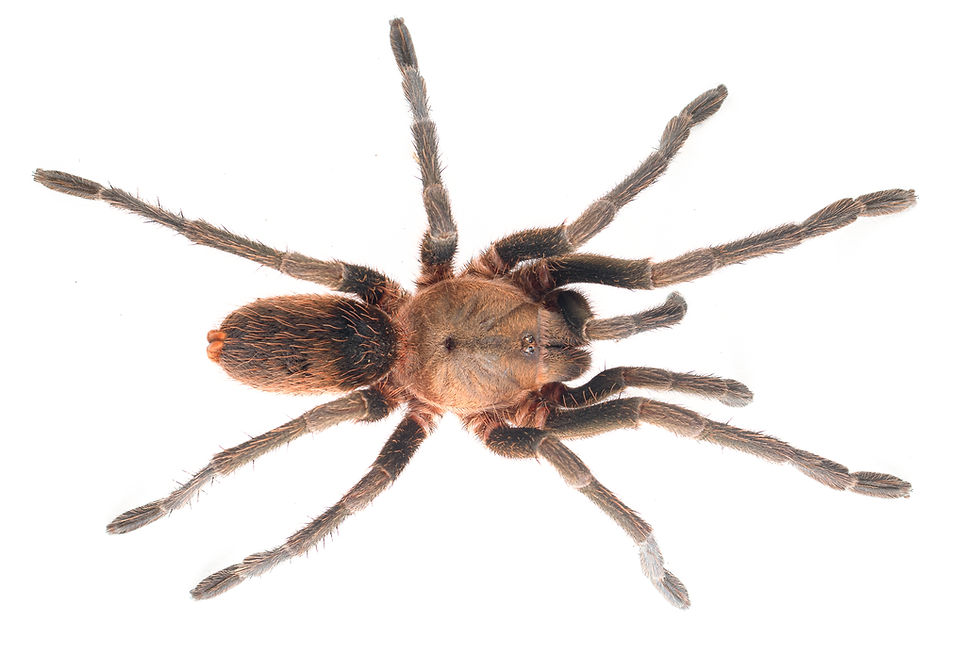
Psalmopoeus reduncus is a medium-sized arboreal tarantula readily distinguished among Costa Rican theraphosids by its generally dark brown to black coloration and the presence of distinctly orange to reddish buccal setae and cheliceral margins, a character consistently reported since its redescription for Costa Rica (Valerio, 1979). Based on prosoma measurements, adult females possess a carapace length of approximately 15.0–20.0 mm, while adult males measure about 12.5–15.0 mm (Valerio, 1979), corresponding to an estimated total body length of roughly 45–55 mm in females and 35–45 mm in males (Peters, 2000; Gabriel, 2008).
Legs are long and slender, showing considerable intraspecific variation in length, particularly in males; published segment measurements indicate an estimated adult leg span of approximately 10–13 cm (Valerio, 1979; Peters, 2000; Gabriel, 2008). The carapace is slightly longer than wide and moderately glossy, while the opisthosoma is oval and uniformly dark, sometimes exhibiting subtle bronze or reddish hues under certain lighting conditions.
Urticating setae are absent, as in other members of Psalmopoeus, and the species shows clear sexual dimorphism: males bear tibial apophyses on leg I and a species-specific palpal bulb, whereas females are more robust and identifiable by paired, moderately sclerotized spermathecae (Valerio, 1979; Gabriel & Sherwood, 2020). Juveniles resemble adults but are smaller and may display less intense cheliceral coloration. Field identification based solely on external coloration may be unreliable due to overlap with congeners, making examination of adult reproductive structures necessary for confident identification (Valerio, 1979; Cifuentes & Bertani, 2022).
Natural History
Psalmopoeus reduncus is a primarily arboreal tarantula inhabiting humid lowland to premontane forests of Costa Rica and adjacent regions of Central America. It is most often found on tree trunks, inside natural cavities, under loose bark, or within crevices of standing trees. The species also occurs in secondary forests and moderately disturbed habitats, including forest edges, as long as adequate arboreal refuges and humidity are present. Individuals typically occupy pre-existing cavities, which they reinforce with silk to form tubular retreats used for shelter and ambush (Valerio, 1979; Peters, 2000; Gabriel, 2008).
The species is strictly nocturnal, remaining hidden during the day and becoming active after dusk. At night, individuals are commonly observed at the entrance of their retreat or moving short distances along tree trunks while foraging. The diet consists mainly of insects and other arthropods; there are no confirmed records of vertebrate prey for this species. Like other members of Psalmopoeus, P. reduncus lacks urticating setae and relies on rapid retreat and threat displays for defense (Schmidt, 1993; Valerio, 1979; Gabriel & Sherwood, 2020).
Reproductive activity appears to be seasonal, with mature males encountered more frequently during wetter periods. Females produce a single egg sac per reproductive event, and juveniles grow slowly, remaining within arboreal retreats for extended periods. Although the general natural history of P. reduncus is well supported by field observations, detailed ecological data on population size, longevity, and reproductive output remain limited, highlighting the need for further focused studies (Valerio, 1979; Peters, 2000; Cifuentes & Bertani, 2022).
Conservation
Psalmopoeus reduncus has not yet been evaluated by the IUCN Red List and is therefore considered Not Evaluated. In Costa Rica, the species is indirectly protected under national wildlife legislation, which regulates the collection and trade of native fauna. Part of its known distribution occurs within protected areas, providing some degree of habitat protection (Valerio, 1979; Gabriel, 2008; World Spider Catalog, 2024).
The main threats to the species are habitat loss and degradation caused by deforestation, agriculture, and urban expansion. As an arboreal tarantula that depends on mature trees with cavities or loose bark, the reduction of forest structure limits the availability of suitable refuges. Although the species can persist in secondary forests, increasing habitat fragmentation may reduce connectivity among populations and raise local extinction risk (Valerio, 1979; Peters, 2000; Gabriel & Sherwood, 2020).
Climate change may pose an additional long-term threat by altering humidity, rainfall patterns, and forest structure, potentially affecting survival and reproduction. Direct persecution by humans and occasional collection for the pet trade also represent localized pressures, although current evidence suggests these impacts remain limited compared to other theraphosids (Schmidt, 1993; Gabriel, 2008; Gabriel & Sherwood, 2020).
Biological traits such as slow growth, delayed maturity, and low reproductive output may hinder rapid population recovery. Due to the lack of population and ecological data, the true conservation status of P. reduncus remains uncertain. Further field surveys, ecological studies, public education, and continued enforcement of wildlife protection laws are recommended to support long-term conservation (Valerio, 1979; Cifuentes & Bertani, 2022).
Distribution
The original type locality of Psalmopoeus reduncus, as indicated by Karsch (1880), is simply “Costa Rica”, without further geographic detail, which is common in early arachnological descriptions. The species was later redescribed and its presence in Costa Rica firmly confirmed based on examined specimens and field observations, establishing it as a native Central American species (Karsch, 1880; Valerio, 1979). Although the type material is historically associated with European museum collections, the exact repository of the original specimens remains unclear (World Spider Catalog, 2024).
In Costa Rica, P. reduncus is known mainly from lowland to premontane humid forests, particularly on the Caribbean slope and in northern and central regions of the country. Valerio (1979) provided the first detailed overview of its national distribution, and later records have confirmed its association with humid forests offering suitable arboreal refuges, although precise locality data remain limited in the literature (Valerio, 1979; Gabriel, 2008).
Outside Costa Rica, the species has been reliably recorded from Panama, representing a confirmed southward range extension within Central America (Gabriel, 2008). There are no verified records from countries north of Costa Rica, indicating that P. reduncus is restricted to the humid lowland and premontane forests of southern Central America (Gabriel & Sherwood, 2020).
Ecologically, the species is associated with humid tropical and premontane life zones, occurring mainly at low to mid elevations. It appears absent from dry forests and high-elevation cloud forests, reflecting its dependence on stable humidity and mature forest structure (Valerio, 1979; Peters, 2000; Cifuentes & Bertani, 2022).
Reports from citizen science platforms should be treated with caution, as reliable identification usually requires examination of adult reproductive structures. Consequently, the currently accepted distribution of P. reduncus is based primarily on published records and examined material, highlighting the need for additional field surveys and well-documented voucher specimens to refine its known range (Valerio, 1979; Gabriel & Sherwood, 2020; World Spider Catalog, 2024).

Etymology
The generic name Psalmopoeus was established by Pocock (1895) and is derived from Greek roots. It combines psalmos (ψαλμός), meaning “stringed instrument” or “harp,” and poiein (ποιεῖν), meaning “to make” or “to produce.” Although Pocock did not provide an explicit explanation for the name, subsequent authors have suggested that it may allude metaphorically to the spider’s elongated legs, elegant posture, or rapid, graceful movements, particularly in arboreal contexts, rather than to any specific morphological structure (Pocock, 1895; Schmidt, 2003; Cifuentes & Bertani, 2022). The genus was erected to accommodate arboreal theraphosids distinct from more terrestrial forms, a concept that remains valid in modern classifications.
The specific epithet reduncus is derived from Latin, meaning “bent backward,” “curved,” or “hooked”, and was introduced by Karsch (1880) in the original description of the species. Karsch did not explicitly state the rationale behind the name; however, later interpretations suggest that it likely refers to a curved or recurved morphological feature, possibly related to the shape of the chelicerae, fangs, or another somatic or genital structure observed in the type material (Karsch, 1880; Valerio, 1979). Such descriptive epithets were commonly used in 19th-century arachnology to highlight subtle anatomical traits rather than coloration or geographic origin.
Taken together, the binomen Psalmopoeus reduncus can be interpreted as referring to an elegantly built arboreal tarantula characterized by a recurved or curved anatomical feature, consistent with the species’ gracile body form and arboreal habits. While the precise feature that inspired the epithet remains uncertain due to the lack of explicit explanation in the original description, the name aligns well with both the morphology and behavioral ecology of the species as currently understood (Karsch, 1880; Valerio, 1979; Gabriel & Sherwood, 2020).
Synonymy
Psalmopoeus reduncus was originally described by Karsch (1880) as Lasiodora redunca Karsch, 1880, based on material broadly attributed to “Costa Rica” as the type locality. This generic placement reflects the taxonomic practices of the late 19th century, when many Neotropical theraphosids were assigned to broadly defined genera without detailed justification (Karsch, 1880; World Spider Catalog, 2024).
Later taxonomic revisions transferred the species to the genus Psalmopoeus Pocock, 1895, based on improved understanding of arboreal theraphosid morphology and diagnostic characters. The resulting combination, Psalmopoeus reduncus (Karsch, 1880), has been consistently accepted in subsequent taxonomic treatments and catalogs (Simon, 1903; Valerio, 1979; World Spider Catalog, 2024).
The species has not accumulated numerous junior synonyms but has historically been confused with congeners due to similar coloration and arboreal habits. Valerio (1979) clarified its diagnostic characters in his redescription for Costa Rica, and later revisions have further stabilized the species concept (Gabriel & Sherwood, 2020; Cifuentes & Bertani, 2022).
At present, Psalmopoeus reduncus (Karsch, 1880) is recognized as the valid name and is listed as such in authoritative taxonomic databases. The original type material is presumed to be housed in European museum collections, although precise repository details remain unclear in early literature (World Spider Catalog, 2024; Sherwood et al., 2022).
Chronological synonymy:
Lasiodora redunca Karsch, 1880 — original combination
Psalmopoeus reduncus (Karsch, 1880) — current valid combination
Remarks / Curiosities
Unlike many New World tarantulas, P. reduncus lacks urticating setae, a characteristic shared with other members of the genus Psalmopoeus. Instead of relying on hair flicking for defense, this species depends on speed, agility, and intimidation displays, including raising the anterior legs and prominently exposing the chelicerae. This behavioral strategy, combined with its arboreal habits, contributes to its reputation among observers as a fast and alert spider, even though it is generally reclusive and avoids confrontation when undisturbed (Schmidt, 1993; Gabriel & Sherwood, 2020).
The species is also of interest from a biogeographic perspective, as it was long considered endemic to Costa Rica until confirmed records from Panama extended its known range. This highlights how incomplete sampling and limited access to arboreal habitats can obscure the true distribution of tropical theraphosids. The history of P. reduncus underscores the importance of continued field surveys and taxonomic work in Central America, particularly for canopy- and trunk-dwelling spiders that are less frequently encountered than terrestrial species (Valerio, 1979; Gabriel, 2008).
Literature Cited
Cifuentes, Y., & Bertani, R. (2022). Taxonomic revision and cladistic analysis of the tarantula genera Tapinauchenius Ausserer, 1871, Psalmopoeus Pocock, 1895, and Amazonius n. gen. (Theraphosidae, Psalmopoeinae). Zootaxa, 5101(1), 1–123. https://doi.org/10.11646/zootaxa.5101.1.1
Gabriel, R. (2008). Psalmopoeus reduncus (Karsch, 1880) a theraphosid spider new to Panama. Newsletter of the British Arachnological Society, 112, 8–10.
Gabriel, R., & Sherwood, D. (2020). Revised taxonomic placement of some Mesoamerican Psalmopoeus Pocock, 1895, with description of three new species (Araneae: Theraphosidae). Arachnology, 18(4), 387–398. https://doi.org/10.13156/arac.2020.18.4.387
Karsch, F. (1880). Arachnologische Blätter (Decas I). Zeitschrift für die Gesammten Naturwissenschaften (Dritte Folge), 5, 373–409.
Peters, H.-J. (2000). Tarantulas of the world: Kleiner Atlas der Vogelspinnen (Vol. 2). Published by the author.
Peters, H.-J. (2003). Tarantulas of the world: America’s Vogelspinnen. Published by the author, Wegberg, Germany.
Schmidt, G. (1993). Vogelspinnen: Vorkommen, Lebensweise, Haltung und Zucht, mit Bestimmungsschlüsseln für alle Gattungen (4th ed.). Landbuch Hannover.
Schmidt, G. (2003). Die Vogelspinnen: Eine weltweite Übersicht. Neue Brehm-Bücherei, Hohenwarsleben.
Sherwood, D., Logunov, D. V., & Gabriel, R. (2022). An annotated catalogue of the theraphosid spiders held in the collections of the Manchester Museum (Araneae: Theraphosidae). Arachnology, 19(Special Issue), 209–219. https://doi.org/10.13156/arac.2022.19.sp1.209
Simon, E. (1903). Histoire naturelle des araignées (2nd ed., Vol. 2). Roret, Paris. https://doi.org/10.5962/bhl.title.51973
Valerio, C. E. (1979). Arañas terafósidas de Costa Rica (Araneae: Theraphosidae). II. Psalmopoeus reduncus, redescripción, distribución y el problema de dispersión en terafósidas. Revista de Biología Tropical, 27, 301–308.
World Spider Catalog. (2024). Psalmopoeus reduncus (Karsch, 1880). Natural History Museum Bern. Retrieved from https://wsc.nmbe.ch/spec-data/44471
Disclaimer
This section was prepared by a team of dedicated enthusiasts and biologists with a strong interest in Costa Rica’s native tarantulas. The information presented here is based on publicly available scientific literature, verified observational records (including citizen science platforms), and collective field experience.
While every effort has been made to ensure accuracy, this content has not yet undergone formal peer review by a professional arachnologist specializing in Theraphosidae. As such, we recommend that taxonomic or ecological interpretations especially those used in scientific or conservation contexts be independently reviewed by qualified specialists in the field.
We actively welcome collaboration with professional arachnologists and invite readers to contribute verified data, photographs, corrections, or updates. Our goal is to continually refine and expand this resource to support greater understanding, appreciation, and protection of Costa Rica’s remarkable tarantula fauna.


Comments