Aphonopelma crinirufum (Valerio, 1980): Costa Rican Dry Forest Tarantula.
- Cristian Porras Ramirez
- Oct 19, 2025
- 5 min read

Updated: Dec 30, 2025
Tarantulas of Costa Rica | Theraphosidae
English common names:
Costa Rican Dry Forest Tarantula, Reddish Costa Rican Tarantula, Crinirufum Tarantula, Rust-Bodied Tarantula, Costa Rican Forest Tarantula.
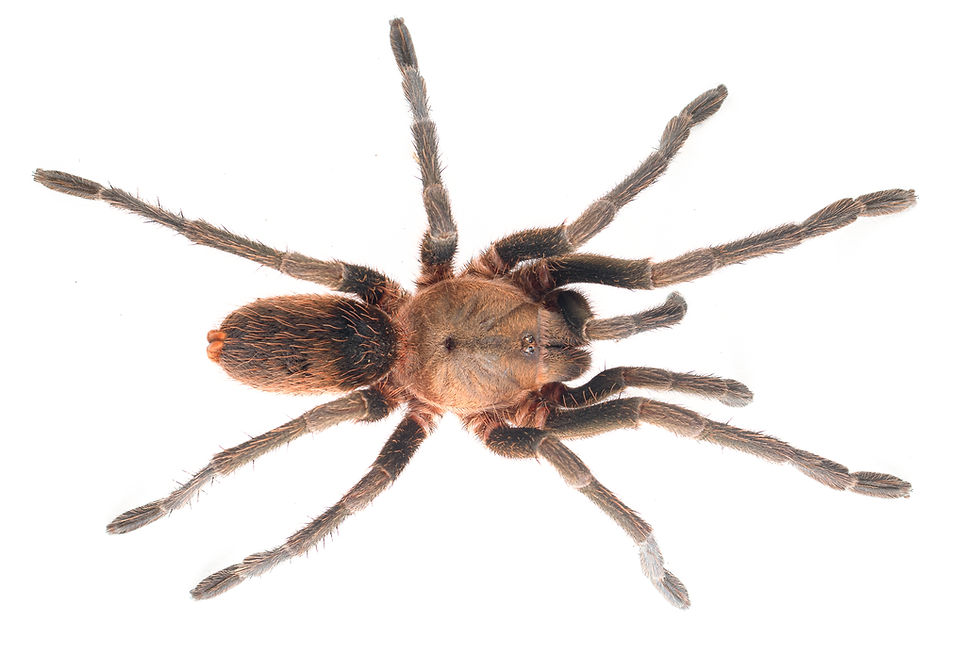
Recognition: ♂♂ ~33 mm ♀♀ ~40 mm (approx). Aphonopelma crinirufum, also known as the Blue-Fronted Tarantula (Tarántula frente azul in Spanish), is a medium-sized terrestrial tarantula endemic to Costa Rica (Valerio, 1980; Venegas, 2020). It is easily recognized by its reddish to dark brown carapace, which sometimes shows bluish or purplish reflections near the anterior edge (Venegas, 2020). The abdomen is densely covered with reddish-brown silky setae, giving it a velvety appearance.
Adult males are slender and display prominent tibial apophyses on leg I and a narrow, ventrally curved palpal bulb (Valerio, 1980). In contrast, females are larger and more robust, with bilobed spermathecae that are deeply notched medially. This species lacks the stridulatory lyra (specialized sound-producing setae) found in some related genera, a trait that led to its reclassification from Citharacanthus to Aphonopelma (Rudloff, 1997).
Juveniles and females may resemble Aphonopelma burica, but A. crinirufum generally has longer legs and duller overall coloration (Valerio, 1980). Like other Aphonopelma, it likely inhabits burrows or crevices in humid forest floors, where it remains hidden during the day.
Natural History: Aphonopelma crinirufum is a terrestrial and nocturnal tarantula endemic to northwestern Costa Rica, particularly in Guanacaste, northern Puntarenas, and parts of western Alajuela and the Central Valley (Valerio, 1980; Schmidt, 2003; Venegas, 2020). Originally documented in tropical dry forests, the species has also been observed in moist transitional zones and disturbed habitats, including shade-grown coffee plantations, pastures with tree cover, and rural gardens (Venegas, 2020).
Although no formal altitudinal range has been published, citizen science data indicate that most individuals are encountered between 150 and 900 meters above sea level. These tarantulas prefer microhabitats such as leaf litter, under logs, and shallow burrows in shaded, seasonally humid environments.
Activity begins shortly after dusk, when individuals emerge to ambush small arthropods near the entrance of their retreat. During daylight hours, they remain concealed to avoid desiccation and potential predators. Males are most commonly seen from May to July, coinciding with the early rainy season, during which they roam in search of mates. Females tend to be sedentary and may reuse the same burrow or shelter for several consecutive years (Valerio, 1980; Schmidt, 2003).
Conservation: Aphonopelma crinirufum is not currently evaluated by the IUCN Red List and lacks formal conservation status under Costa Rican environmental law. The species was originally described from northwestern Costa Rica, specifically Guanacaste and Puntarenas (Valerio, 1980). Although no population data exist, field reports and citizen science observations suggest it remains locally common in suitable habitats.
Its presence in semi-disturbed environments, such as shade-grown coffee farms, rural gardens, and forest edges, points to some ecological resilience. It is not listed under CITES, and no direct threats have been formally documented. However, habitat degradation, land-use change, and collection for the exotic pet trade may threaten certain populations. As an endemic species with a potentially fragmented distribution and no long-term monitoring, A. crinirufum would benefit from further ecological assessment.
Distribution: Aphonopelma crinirufum was originally described from northwestern Costa Rica, where it is primarily associated with the tropical dry and transitional moist forests of the Pacific slope. Verified records from iNaturalist (2023–2025) confirm its presence in provinces such as Guanacaste, northern Puntarenas, and western Alajuela, particularly in areas like Cañas, Bagaces, Abangares, and the lower slopes of the Tilarán and Guanacaste mountain ranges.
The species is most frequently found in a mosaic of tropical dry forest, moist premontane forest, and disturbed secondary habitats, including agroforestry systems. It appears to favor environments with seasonal rainfall and moderate canopy cover, often occurring at elevations between 150 and 900 meters above sea level. Unlike many other Costa Rican tarantulas, A. crinirufum thrives in ecosystems typical of the Pacific northwest, where deciduous trees, scattered vegetation, and dry-season leaf litter provide ideal camouflage and shelter.

Etymology: The scientific name Aphonopelma crinirufum combines Greek and Latin roots that describe key traits of the species. The genus name Aphonopelma comes from the Greek words a- (“without”), phono (“sound”), and pelma (“sole” or “foot”), referring to the absence of stridulatory organs used for sound production—a defining feature of this genus. The species epithet crinirufum derives from the Latin crini (“hair”) and rufum (“reddish” or “rust-colored”), in reference to the dense, reddish hairs that cover much of the spider’s body, especially the abdomen and legs. Together, the name can be interpreted as “the mute-footed tarantula with reddish hairs.” The species was originally described as Citharacanthus crinirufus by Valerio in 1980 but was later transferred to Aphonopelma by Rudloff (1997) after reviewing its morphological traits.
Synonymy
Aphonopelma crinirufum was originally described by Valerio (1980) as Citharacanthus crinirufus, based on female specimens from Costa Rica (Guanacaste and Puntarenas), with illustrations provided in the original description. The male was later described and illustrated by Smith (1987), and the female was subsequently figured in a regional guide by Hancock & Hancock (1989). Rudloff (1997) re-examined a male paratype and transferred the species to the genus Aphonopelma based on the absence of a stridulatory lyra, establishing the currently accepted combination Aphonopelma crinirufum. Both sexes were later illustrated and discussed in detail in European monographs and syntheses by Peters (2003) and Schmidt (2003a, 2003b), confirming the generic placement and stabilizing the taxonomic concept of the species.
Citharacanthus crinirufus Valerio, 1980: 277, figs. 8–9, 15, 19 — original description of female (♀); described from Costa Rica (Guanacaste and Puntarenas).
Citharacanthus crinirufus Smith, 1987: 51, fig. 69 — male (♂) described and illustrated.
Citharacanthus crinirufus Hancock & Hancock, 1989: 51, fig. 46 — female (♀) figured in regional guide.
Aphonopelma crinirufum Rudloff, 1997: 9 — male paratype re-examined; species transferred from Citharacanthus to Aphonopelma based on absence of stridulatory lyra.
Aphonopelma crinirufum Peters, 2003: 49, figs. 175, 179–180 — male and female (♂♀) illustrated in European monograph.
Aphonopelma crinirufum Schmidt, 2003a: 9, fig. 2 — female (♀) discussed in Tarantulas of the World.
Aphonopelma crinirufum Schmidt, 2003b: 145, figs. 249–251 — male and female (♂♀) further illustrated and confirmed.
Literature Cited:
Hancock, R., & Hancock, T. (1989). Tarantulas of Central America. Exotic Pets, 3(4): 43–59.
Peters, H. (2003). Die Vogelspinnen. Landbuch Verlag. 208 pp.
Rudloff, J.-P. (1997). Neue Erkenntnisse über die Gattung Aphonopelma Pocock, 1901. Arachnologisches Magazin, 5(3): 8–11.
Schmidt, G. (2003). Vogelspinnen: Eine weltweite Übersicht. Landbuch Verlag, Hannover. 383 pp.
Smith, A. M. (1987). The Tarantula: Classification and Identification Guide. Fitzgerald Publishing, London. 178 pp.
Valerio, C. E. (1980). Arañas terafósidas de Costa Rica. Revista de Biología Tropical, 28(2): 271–296.
iNaturalist. (2025). Observations of Aphonopelma crinirufum. https://www.inaturalist.org/taxa/68739
Disclaimer
This section was prepared by a team of dedicated enthusiasts and biologists with a strong interest in Costa Rica’s native tarantulas. The information presented here is based on publicly available scientific literature, verified observational records (including citizen science platforms), and collective field experience.
While every effort has been made to ensure accuracy, this content has not yet undergone formal peer review by a professional arachnologist specializing in Theraphosidae. As such, we recommend that taxonomic or ecological interpretations especially those used in scientific or conservation contexts be independently reviewed by qualified specialists in the field.
We actively welcome collaboration with professional arachnologists and invite readers to contribute verified data, photographs, corrections, or updates. Our goal is to continually refine and expand this resource to support greater understanding, appreciation, and protection of Costa Rica’s remarkable tarantula fauna.


Comments